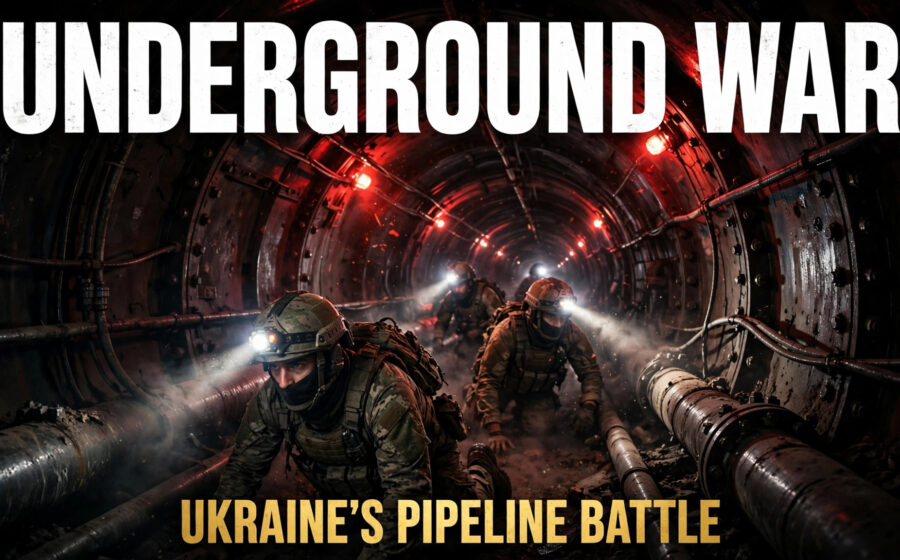
A new front has opened in the war in Ukraine, and it is underground. For the past seven months, Ukrainian troops have been living and fighting Russian forces inside a disused Soviet-era gas pipeline in the north-eastern Kharkiv region, in a subterranean battle that the BBC’s defence correspondent has now witnessed first-hand.
The pipeline is barely more than a metre wide. Inside, there is only room to crawl. Yet for the soldiers of Ukraine’s 13th Khartiia Brigade, going below ground has become the only realistic way to keep fighting — because the skies above the front line are now so thick with drones that moving in the open has become almost impossible.
“On the surface you always have some room to manoeuvre, but here you can only engage the enemy head-on,” said Zanuda, the officer who helped plan the tunnel operation and who describes it as a new world of fighting. “Ground operations are now nearly impossible. Everyone understands, for now, the only way to fight is underground.”
The BBC’s Jonathan Beale is the first international broadcaster to enter the pipeline, travelling with the brigade near the city of Kupyansk. Reaching the tunnel entrance was itself a reminder of the dangers above ground: a high-speed drive across open fields, followed by a long march over muddy terrain, with Ukrainian troops carrying their weapons loaded and ready to shoot down Russian drones.
At the entrance, the first thing to hit visitors is the lingering smell of gas and stale air. Both sides use openings in the pipe to reach the surface, where most of the fighting takes place, cutting through the thick steel with welding tools and digging breaches in the ground.
It was the Russians who first turned the pipeline into a weapon. In September 2025 they used it to infiltrate Kupyansk, and they had done the same before — during the capture of Avdiivka in 2024, and again in their attempt to retake territory in Russia’s Kursk region. But over the past seven months, Ukrainian forces have slowly turned the tables.
The operation, codenamed Veles after a mythical Slavic god of the underworld, began in April. Since then, Ukrainian troops have advanced 15 kilometres — just over nine miles — along the pipe. It has been painstaking, backbreaking work, carried out in the constant fear of meeting the enemy face to face in a space too narrow to turn around in.
Troops move through the tunnel on a specially designed electric cart, which they have nicknamed the Kupyansk metro. The ride takes around 40 minutes, heads bowed and legs crossed, with a regular bump as the cart crosses each welded section of pipe. At a break in the pipeline, Ukrainian soldiers have built dugouts to store ammunition and equipment, with just enough room to stand. It is there that a soldier known as Musician directs the movement of troops and supplies. He has spent the past three months underground, surfacing only briefly to wash or use the toilet, and says he can hear the thud of artillery rounds above. “But it’s safe underground,” he said.
That safety is relative. “It’s more comfortable in the pipe because drones don’t fly here, and neither do artillery shells or glide bombs,” said Vovochka, a soldier who has been fighting on the surface for the past three weeks. But there has been fighting inside the pipeline too, and advancing through it means clearing rubble, water and Russian barricades — some of them booby-trapped, some piled with the bodies of dead Russian soldiers. “When we moved them or climbed over them, we had no idea what was underneath,” said Chyzh, another soldier from the brigade. The other danger, he said, was gunfire in the confined space: “You never know where a bullet is going to go or how it will bounce.”
His comrade Kort said the brigade had killed more than 100 Russian soldiers and taken 30 prisoners during the operation. “Yes, there were bodies,” he said. “I even had to sleep right next to them.”
Hundreds of Colombian volunteers have also taken part, serving with the RUG 23rd Assault Regiment as foreign fighters help fill Ukraine’s depleted ranks. One of them, who goes by the call sign Gecko, said it took his unit 30 days to clear just 500 metres of pipe. “It was difficult, it was hot and I had fear inside the pipe,” he said. “But at some point I just thought, OK, just deal with it and let’s advance.”
Life underground takes a physical and psychological toll. Soldiers spend much of their time on their knees and suffer abrasions. Their commander, Biashym, a former miner whose earlier career helped prepare him for the challenges of operating below ground, said some of his men have had panic attacks from living in such a confined space, and others have struggled to breathe.
The battle of the pipeline is not over. Russian forces have built fortified positions inside the pipe as well, and they still try to infiltrate Ukrainian positions, burrowing in and out. From a control room above ground, the BBC watched Ukrainian drones target another Russian attempt to outflank them. Above the surface, the fighting continues too — in the air and on the ground — as part of a combined operation.
President Volodymyr Zelensky has hailed the operation as a success. It has helped retake lost territory and given Ukrainian morale a boost, but on its own it has not changed the course of the war. Seven months of work have cleared 15 kilometres of pipeline, and the soldiers involved believe there will be more missions like this one. As Zanuda put it: “Pipelines run everywhere. You have to remember, back in the Soviet times, oil, gas and ammonia were being transported to Europe, with the entire transit route running through Ukraine.”
Source: BBC News, “Inside the old gas pipeline where Ukraine is fighting an underground war with Russia” by Jonathan Beale (https://www.bbc.co.uk/news/articles/c32l507ev4v4o).