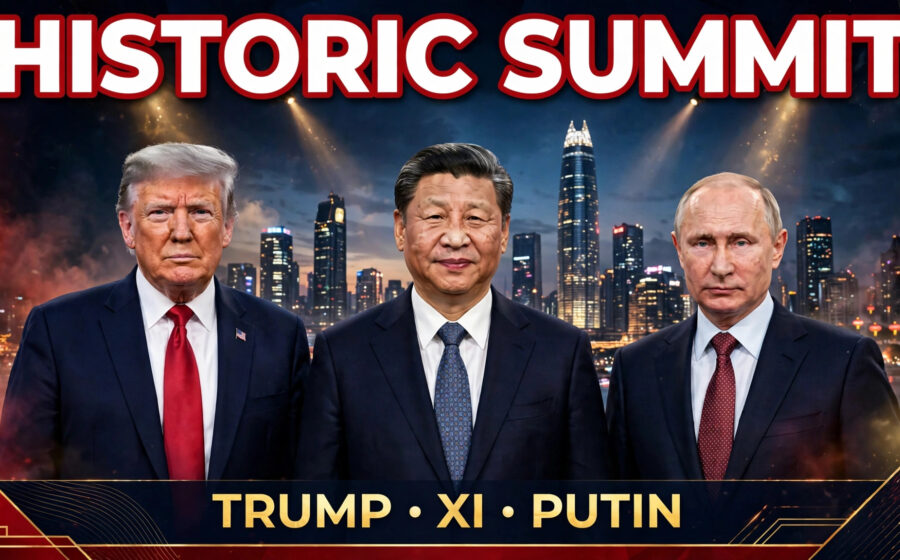
US President Donald Trump has arrived in China for the first-ever trilateral meeting between the leaders of the United States, China and Russia, a gathering that will bring the three most powerful heads of state in the world to the same table for the first time.
Trump touched down in Shenzhen on Wednesday, where Chinese President Xi Jinping personally greeted him at the airport with a handshake and an embrace on the tarmac. The warm welcome was a rare gesture, and one that mirrored the reception Trump gave Xi during the Chinese leader’s state visit to Washington in September.
Russian President Vladimir Putin had arrived in the southern Chinese tech hub earlier on Wednesday. Unlike Trump, Putin was not greeted at the airport by Xi, despite the two leaders’ longstanding partnership, according to the Associated Press.
The three leaders are scheduled to sit down together on Thursday, 19 November, on the sidelines of the Asia-Pacific Economic Cooperation (APEC) summit. The White House confirmed the meeting last week, and China’s foreign ministry confirmed on Monday that it would take place in Shenzhen. The Kremlin has also confirmed Putin’s participation.
It will be the first time the sitting leaders of the three countries have held a three-way meeting. The three men last attended the same international summit at the G20 in Osaka, Japan, in 2019, but they did not hold trilateral talks on that occasion.
Nuclear arms at the top of the agenda
The meeting is expected to focus on nuclear non-proliferation. Trump has said he wants to discuss limiting nuclear weapons with Xi and Putin, and the White House said the talks would centre on a possible new agreement between the world’s biggest nuclear-armed states.
The issue has gained urgency since the last nuclear arms treaty between the United States and Russia, known as New START, expired in February 2026. No replacement agreement has been reached, leaving the world’s two largest nuclear arsenals without a formal treaty limiting them for the first time in decades.
China, which is rapidly expanding its own nuclear arsenal, has never been part of a trilateral arms control agreement with the United States and Russia, making the Shenzhen meeting a significant diplomatic first even before any deal is discussed.
A senior US official has played down expectations, however, telling reporters: “We do not expect to get to any kind of agreement.” Analysts say the meeting is likely to be heavier on symbolism than on substance, with form mattering more than any breakthrough.
Ukraine, Iran, trade and AI on the table
The talks are also expected to cover Russia’s war in Ukraine, now in its fifth year, the US-Israeli war against Iran, trade tensions between Washington and Beijing, and artificial intelligence.
Trump has said he intends to discuss ending the war in Ukraine with both leaders, although his aides had earlier told reporters that Ukraine would not be part of the trilateral meeting. Ukrainian President Volodymyr Zelenskyy has expressed concern that the summit could become a platform for discussing a possible Ukraine deal behind Kyiv’s back.
The meeting comes against a backdrop of rising tensions in the Gulf, where the United States has struck Iranian targets in recent days and Iran has fired drones at American bases in Bahrain and Kuwait. A White House spokeswoman said Trump would also discuss the US-Israeli war against Iran with the two leaders.
Trade is also likely to feature heavily. Speaking at the APEC summit on Wednesday, Xi called for an end to trade “protectionism” and urged countries to support free and open trade. Putin, addressing the APEC CEO Summit, criticised Western sanctions against Russia.
Putin said on Wednesday that he expected “big potential benefit” from the trilateral meeting, telling business leaders at the APEC CEO Summit that the talks held significant potential. Xi, meanwhile, called on regional economies to work together to build an Asia-Pacific community focused on shared prosperity.
A summit heavy on symbolism
The gathering has drawn comparisons with the 1945 Yalta summit, when the leaders of the United States, Britain and the Soviet Union met to shape the post-war world. But commentators have stressed that the comparison is about symbolism, not substance: no Yalta-style agreement has been reached or announced, and none is expected.
Trump has also teased the possibility of a private meeting with Putin on the sidelines of the summit, and has not ruled out a meeting with North Korean leader Kim Jong Un in China this week, saying whether such a meeting could be arranged was up to Xi.
For China, the APEC summit is a chance to show off Shenzhen, a fast-growing coastal metropolis that has transformed from a small fishing village into a global technology hub in just a few decades. The city is hosting world leaders for the APEC Economic Leaders’ Meeting, which runs from 18 to 19 November.
The leaders of APEC’s 21 member economies, which account for around 60 per cent of global economic output and nearly half of world trade, are gathering at a time of heightened geopolitical tension, with wars in Ukraine and the Gulf, trade disputes and rapid advances in artificial intelligence all competing for attention.
Whether the first-ever Trump-Xi-Putin meeting produces anything concrete remains to be seen. But the image of the three leaders sitting down together in Shenzhen is already one of the most striking diplomatic moments of the year — and a reminder of how much of the world’s future is decided when its most powerful leaders meet face to face.
Sources: BBC News, CNN, The Indian Express, The Hindu, Al Jazeera. CNN | The Indian Express